
In brief
- Dancehall lyrics are in Patois, a language with its own sounds and grammar, and deejays deliver them fast over a riddim. The small grammar words are the easiest to miss.
- A few sound rules decode many words. Patois has no "th" sound, so "thing" is ting and "the" is di, and a word that starts with "st" can lose the s, so "stop" becomes tap.
- The slang is easier to learn by theme: the dance, romance, money, guns, faith and cussing.
- Jamaican radio does not play every song. Broadcasting Commission directives in 2009 and 2022 told stations not to air songs that glorify guns, scamming or explicit sex, and a bleeped edit was no way around them.
A dancehall tune can sound like English you almost understand, until a line rushes past and you catch none of it. The lyrics are in Patois, Jamaica’s own language, and the deejay is chatting fast over a riddim, so the small words blur together. Learn a few sound rules and a dozen small words, and most lines start to make sense.
Why dancehall lyrics are hard to follow
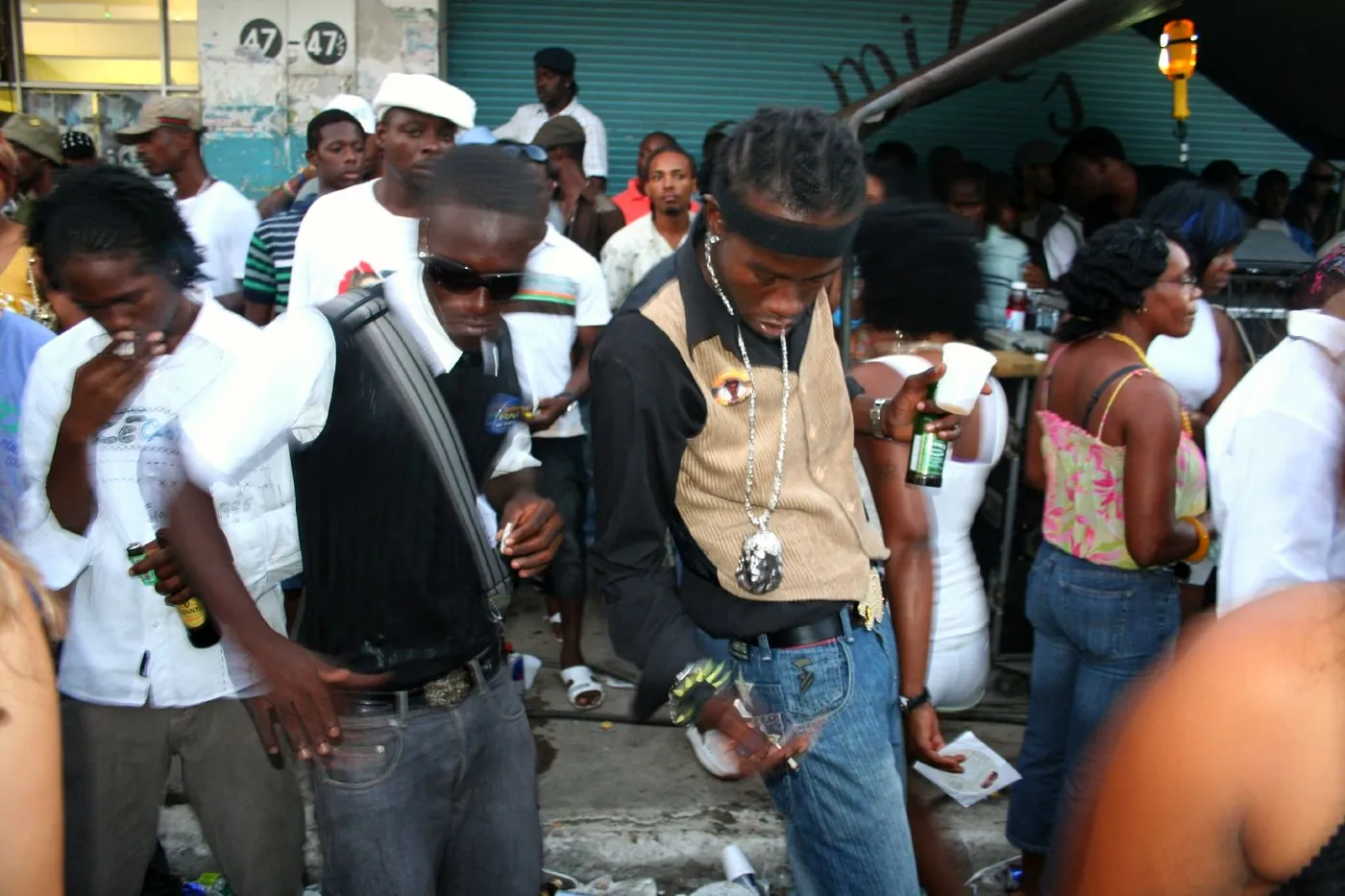
Dancehall emerged in the late 1970s and is named after the outdoor venues where sound systems held their parties1. Its stars are deejays: performers on the microphone, not the people playing the records. The Institute of Jamaica describes deejays toasting, freestyle rapping over dub tracks1. The lyrics still come that way, fast and full of slang.
A word you know can also arrive in a shape you don’t recognise, because Patois says many English words differently. And the words that carry the grammar are short and unstressed, so they are the first to vanish at speed.
The sounds: how English words change in Patois
Patois has neither of the two English “th” sounds, the ones in “thick” and “this”2. Where English has one, you will usually hear a t or a d:
- “thing” is ting and “think” is tink
- “the” is di, “them” is dem, “this” is dis, “that” is dat and “with” is wid
Some sounds at the start of a word are dropped or added. A word that begins with “st”, “sp” or “sk” often loses the s, so “stop” can be tap and “split” can be plit, and an h at the front comes and goes from one speaker to the next3.
Some common words have a shape of their own: gyal (girl), bwoy (boy), bredda (brother), cyaa (can’t) and nuff (plenty, from “enough”).
The small words that carry the meaning
These are the words easiest to miss. Patois uses a handful of short words where English changes the verb or adds a helper, and a whole line can turn on one of them3.
| Patois | What it does | Example |
|---|---|---|
| mi | I, me, my | Mi deh yah. (I’m here.) |
| im | he, she, him, her | Im gone. (He’s gone, or she’s gone.) |
| unu | you, when it means more than one person | Unu ready? (Are you all ready?) |
| dem | they, them; after a noun it makes the plural | di gyal dem (the girls) |
| a | before a verb: is, am or are doing it now | Mi a come. (I’m coming.) |
| a go | going to | It a go rain. (It’s going to rain.) |
| nuh | not, don’t | Mi nuh know. (I don’t know.) |
| fi | to, for; also “should” | Mi love fi dance. (I love to dance.) |
| seh | say; also “that” | Mi know seh yuh a lie. (I know that you’re lying.) |
| deh | there; to be somewhere | Weh yuh deh? (Where are you?) |
| pon | on | pon di road (on the road) |
Linguists write some of these differently, with se for seh and de for deh, but the sounds are the same3.
Dancehall slang, theme by theme
Many slang words have a street meaning on top of an everyday one, so the subject of the song matters.
The dance
A big tune is a hit, and the crowd calls for a pull-up so the selecta runs it back from the top. Big up is a shout-out of praise. Vibes is the feeling in the place, and a packed, lively night is a bashment. The sound system guide covers the words of the dance in depth.
Love, women and the floor
Gyal means a girl or woman, and wifey is the main partner, set against the matey, the other woman. Ting can mean a girlfriend. On the dance floor, to wine is to roll the waist and hips, and to bubble is to dance with an easy, rolling motion.
Money and status
Paper is money and bling is flashy jewellery. A don is a powerful man who runs his community, and your ends is the area you come from. Some songs are about the scamming trade5, so you will hear scamma and lotto scam, and the Probox, the small Toyota wagon that is the hustler’s work car.
Guns and badness
A gun tune is a song about guns and violence. Badman and shotta describe the gunmen in them, though badman can also be praise for someone skilled. Strap, skeng, matic and draco all mean a gun, and an informer is someone who talks to the police, one of the worst things to be called in these songs.
Faith and conscious lyrics
Reggae’s ties to the Rastafari movement grew in the 1970s, and the music became a way to speak about society and politics1. You hear its words in dancehall too. Jah is God, and Selassie I is Emperor Haile Selassie of Ethiopia, revered in Rastafari. Babylon is the oppressive system, often meaning the police, and Zion is the promised land. I and I can mean I, me or we. To bun fire on something is to condemn it.
Cussing and disses
The claat words, bumboclaat, raasclaat and bloodclaat, are among the strongest swear words in Jamaica. Dutty means dirty, eediat is idiot, a waste man is good for nothing, and a badmind person is spiteful and envious. The dictionary also lists the slurs aimed at gay men, such as battyman and chi chi man, with a warning label so you know what you are hearing.
Slackness and culture
Two words describe the opposite ends of the music. Slackness is lyrics that are sexually explicit. Culture means conscious lyrics with a social or spiritual message, which the dictionary lists under conscious music.
The Jamaican scholar Carolyn Cooper, who started the Reggae Studies Unit at the University of the West Indies, took the title of her 1989 essay “Slackness Hiding from Culture” from a Josey Wales tune6. She argues that intellectuals are wrong to dismiss the lyrics of dancehall artists6.
Why the radio version sounds different
Jamaica’s Broadcasting Commission regulates what stations air. In February 2009 it banned broadcasts of songs that promote daggering, a rough dance that simulates sex, along with other explicit sexual content, and it ruled out bleeped edits of those songs4. Two weeks later it extended the ban to any genre, and to recordings that glorify guns or violent crimes such as murder4.
In October 2022 the Commission told broadcasters not to air any recording that promotes or glorifies scamming, drug abuse or gun violence, and said an edited version of such a song was also prohibited5. So a tune that rules the dance can still be missing from Jamaican radio.
How to decode a line yourself
Take a line like this one:
Mi tink seh di gyal dem a come, but dem cyaa find di place.
I think the girls are coming, but they can't find the place.
- Say it out loud. Many words are English in a Patois shape, and they come clear when you hear them.
- Put the sounds back. Tink is think, with t for “th”, and di is the.
- Find the grammar words. Seh is “that”. Dem after gyal makes it “the girls”, a before come makes it “are coming”, and cyaa is can’t.
- Look up what is left. Paste a line into the translator and it lists the dictionary words it found, or search the dictionary.
- Think about what kind of tune it is. Strap is a leather belt at home and a gun in a gun tune.
To practise, try the dancehall slang quiz or browse every word in music, reggae and dancehall.
Common questions
-
Why are dancehall lyrics so hard to understand?
They are in Patois, which has its own sounds and grammar, and deejays chat them fast over a riddim. Knowing that "th" becomes t or d, and learning the small words such as a, fi, nuh and dem, opens up a lot of lines.
-
What does "big up" mean in a song?
It is a shout-out of praise or respect. "Big up all di ladies" salutes the women in the dance.
-
Are songs censored on Jamaican radio?
The Broadcasting Commission has told stations not to air some songs. Its 2009 directives covered explicit sexual content, including daggering, and songs that glorify guns or violent crime. Its 2022 directive covered songs that glorify scamming, drug abuse or gun violence. Bleeped or edited versions were not allowed as a way around either.
-
What is the difference between slackness and culture?
Slackness is sexually explicit lyrics. Culture is conscious music with a social or spiritual message. The two words are used as opposites.
Sources
- The Evolution of Music in Kingston, Jamaica African Caribbean Institute of Jamaica / Jamaica Memory Bank, Institute of Jamaica
- Jamaican: interdental fricatives Atlas of Pidgin and Creole Language Structures Online (Joseph T. Farquharson)
- A Learner's Grammar of Jamaican The Open Grammar Project
- Broadcasting Commission Brings Soca and Gun Lyrics Under Control Jamaica Information Service
- Broadcasting Commission Ban Not A Restriction on Free Speech Jamaica Information Service
- Celebrating 20th anniversary of Carolyn Cooper's book 'Sound Clash' The Gleaner