
In brief
- Jamaica's traditional dances fall into three families. Some are African-derived and religious, such as kumina. Some came from Europe, such as quadrille and maypole. Others are creole blends, such as Jonkonnu and bruckins.
- Several folk dances belong to wakes and nine-nights, among them dinki mini and gerreh.
- Dancehall dances are often named after the dancer who made them or the song that spread them. The Bogle is named after the dancer Gerald "Bogle" Levy, and the Dutty Wine took off with Tony Matterhorn's 2006 song.
Jamaica’s oldest dances belong to Christmas masquerades, wakes and emancipation celebrations, and some survive today mainly through the national festival competitions2. Its newest are made in the dancehall, where one song can carry a move across the island. Both have given Patois its dance words.
Traditional Jamaican dances
The National Library of Jamaica sorts the island’s traditional dances into three families1:
- African-derived dances such as kumina, myal and pocomania, mainly religious and part of worship. Maroon communities are credited with preserving them.
- European-derived dances such as quadrille and maypole, once religious and now mostly social, often danced to work songs and ring games.
- Creole dances that blend the two, such as Jonkonnu, bruckins and revival.
Jonkonnu
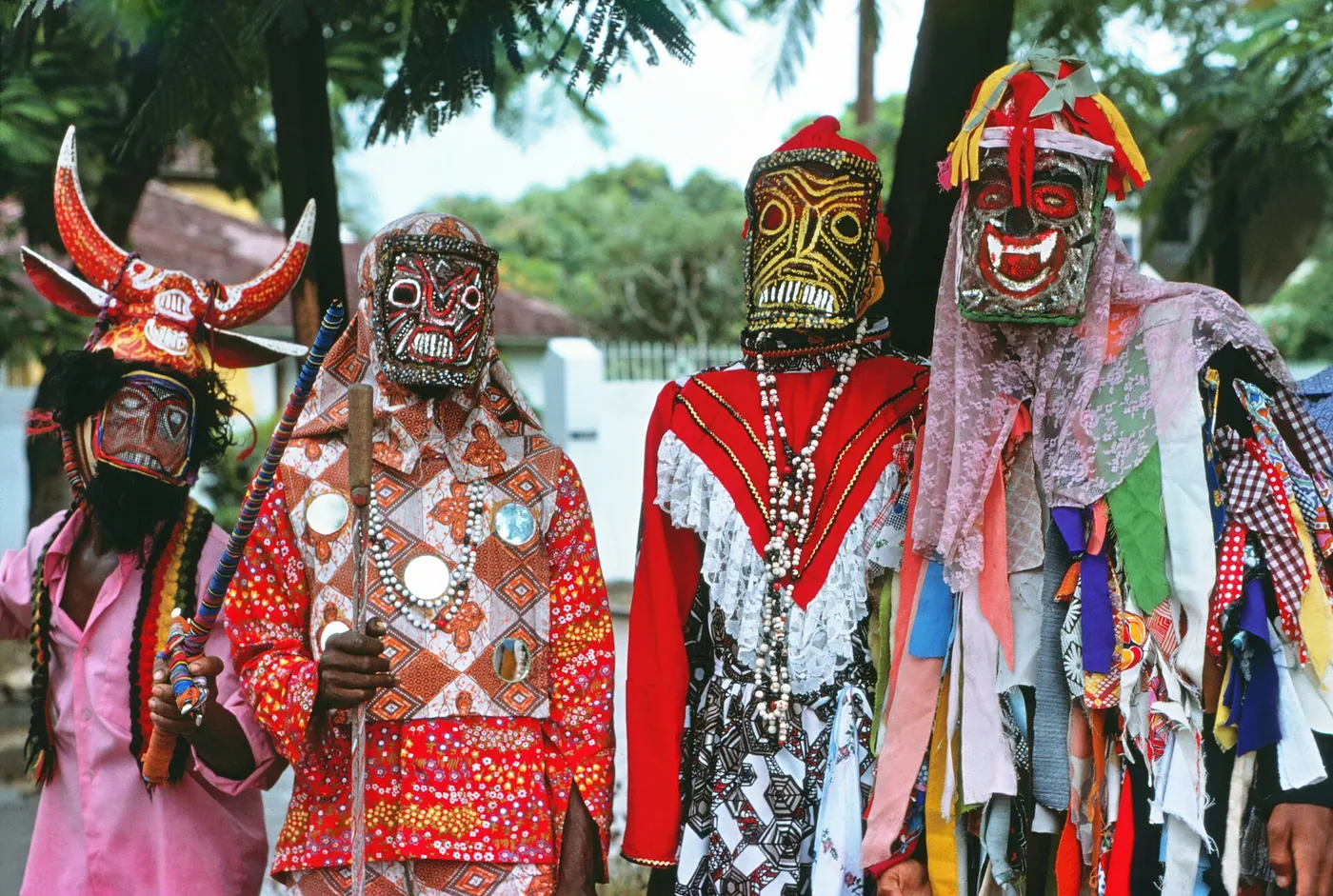
Jonkonnu is a band of masqueraders who perform in towns and villages at Christmas, a custom that goes back to the days of slavery2. The National Library calls it the oldest and most popular of the creole dances1. Its masked characters, such as Pitchy-Patchy and Horse-head, dance from house to house to fife and drum.
Kumina
Kumina is a religious tradition that the Government of Jamaica’s heritage site traces to the Congo2. Its worship centres on drumming, dancing and singing, led by a King or a Queen, and it is performed to celebrate achievements and at set-ups and nine-nights2.
Dinki mini and gerreh
Dinki mini is danced at set-ups and nine-nights after a death, to comfort the family. Its name is said to come from the Congolese word ndingi, a lament or funeral song, and it is still performed in St Mary, St Ann, St Andrew and Portland2. Gerreh is its western cousin, found in Hanover, Westmoreland and St James2.
Bruckins
Bruckins began as a celebration of emancipation in August 1834. It is a pageant of kings, queens, courtiers, soldiers and pages, with a procession and competitive dancing, and it is now performed only in Kensington, Portland2.
Quadrille and maypole
Quadrille and maypole came from Europe1. Quadrille is danced by couples in set figures, in old-fashioned costume. Maypole dancers weave coloured ribbons around a tall pole and unwind them again.
Dancehall dances
Many dancehall moves are named after the dancer who made them or the song that spread them, and the names pass straight into Patois.
The Bogle
The Bogle is named after the dancer Gerald Levy, known as Bogle, who was born in 1964 and came from Lincoln Crescent in Arnett Gardens3. He rose through the Black Roses Crew, led by William “Willie Haggart” Moore, and created his self-titled dance in the early 1990s3. He is also credited with the Urkel, the World-a-Dance and his Wacky dance, which earned him the nickname Mr Wacky3.
Bogle was killed on January 20, 2005, while buying gas on Constant Spring Road in St Andrew3. In 2020 The Economist called him the Godfather of Dancehall3. The Willie Bounce is named in honour of his crew’s leader.
The Dutty Wine
To wine is to roll the waist and hips, and dutty means dirty. The Dutty Wine adds a fast rolling and whipping of the head and neck to the wine. Tony Matterhorn recorded the song “Dutty Wine” in early 2006, inspired by the Attitude Girls dance crew from Montego Bay4. In 2025 the song was certified silver in the United Kingdom, nearly two decades after its release4.
Other dancehall moves
The gully creepa is a low, crouching, gliding step popularised by an Elephant Man song of the same name. A dancehall queen is the top female dancer at the dance, a title fought over in competitions. Not every move reaches the radio: in 2009 the Broadcasting Commission banned broadcasts of songs promoting daggering, a rough dance that simulates sex5.
Dance words in everyday Patois
Many dance words are used off the floor too. To bubble is to dance with an easy rolling motion, and to have a good time. To skank is to dance with a loose, bent-forward step. And a performer who mashes up the place has the whole crowd going wild.
Read next: Jamaican music genres and the Jamaican sound system.
Common questions
-
What are the traditional dances of Jamaica?
Among the best known are Jonkonnu, kumina, quadrille, maypole, bruckins, dinki mini and gerreh. The National Library of Jamaica groups them as African-derived, European-derived and creole.
-
What is Jonkonnu?
A band of masqueraders who perform in towns and villages at Christmas, a custom that goes back to the days of slavery. The National Library calls it the oldest and most popular of the creole dances.
-
Who created the Bogle dance?
The dancer Gerald "Bogle" Levy, in the early 1990s. The dance is named after him.
-
What is the Dutty Wine?
A dancehall dance of fast, circular winding of the waist with a rolling of the head and neck. It took off with Tony Matterhorn's song "Dutty Wine", recorded in early 2006 and inspired by the Attitude Girls dance crew from Montego Bay.
Sources
- Traditional Jamaican Dances National Library of Jamaica Digital Collection
- Jamaica's Heritage in Dance and Music (continued) Jamaica 55, Government of Jamaica
- Six decades later, Bogle's impact on Jamaican culture unmatched The Gleaner (J. T. Davy, August 18, 2024)
- Dutty Wine still in the spin Jamaica Observer (Kevin Jackson, August 19, 2025)
- Broadcasting Commission Brings Soca and Gun Lyrics Under Control Jamaica Information Service