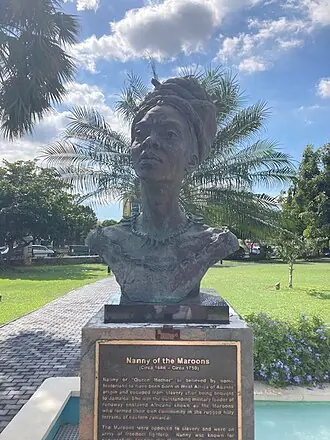

In brief
- Nanny led the Windward Maroons, communities of Africans who had escaped slavery, at the start of the 1700s.
- She was known as a skilled leader of guerrilla warfare in the fight with the British from 1720 to 1739.
- She is one of Jamaica's seven National Heroes, honoured together with Sam Sharpe.
Who Nanny of the Maroons was
Nanny was a leader of the Windward Maroons at the beginning of the 1700s2. The Maroons were Africans who escaped slavery and built free communities in Jamaica’s mountains. Many Jamaicans still call her Granny Nanny1.
Her dates are not known for certain. The government’s list of heroes gives her life as running from some time in the 1600s to some time in the 1740s2. Her own biography gives Ghana as her place of birth1.
What she did
Nanny mattered most in the fight with the British from 1720 to 1739. The government’s biography describes her as an outstanding military leader to the Maroons and to the British settlers alike. She was skilled at organising the guerrilla warfare the Eastern Maroons fought against British troops, and British accounts describe the surprise and fear that Maroon traps caused1.
She was also a leader at home. The biography calls her the chieftainess, or wise woman, of the village, who passed down legends and kept alive the customs, music and songs brought from Africa1. Our dictionary entry for the abeng, the cow’s-horn trumpet blown to send signals across the hills, explains its place in Maroon life.
The 1739 treaty
In 1739 the Maroons made peace with the British. Cudjoe signed the first treaty, for the Leeward Maroons, and a few months later Quao signed a second for the Windward Maroons. Nanny is reported to have been very angry about it. She saw peace on those terms as another form of subjugation1. Accompong, in St Elizabeth, is still a self-governing Maroon town.
What is legend, and what is record
Songs and stories have made Nanny larger than life. Her influence over the Maroons seemed supernatural to many, and the government’s biography notes that it was said to be connected to obeah. It also notes that some legends name several women leaders in this period, but that every legend and document points to Nanny of the First Maroon War as the most outstanding1.
How Jamaica honours her
The Order of National Hero was conferred on Nanny by Government Notice 23 in the Jamaica Gazette, dated March 31, 1982, together with Sam Sharpe1. Her bust stands with those of the other six National Heroes in Emancipation Park, Kingston3.
All seven National Heroes are honoured at the Shrine in National Heroes Park, Kingston4. Jamaicans remember the heroes each October on National Heroes Day.
What the honour means
The Order of National Hero can go to anyone born in Jamaica, or who was a Jamaican citizen at the time of their death, who gave the country “service of a most distinguished nature”. A National Hero is styled The Right Excellent, and the order’s motto is “He built a city which hath foundations”2.
Timeline
Further reading
National Heroes
Jamaica Information Service · Government of Jamaica
The government's own short biography of each of the seven National Heroes, with dates. It is the record our hero pages start from.
Good for:Students and anyone checking a date or a name.
Sources
- Nanny of the Maroons Jamaica Information Service
- Order of National Hero Jamaica Information Service
- Busts of National Heroes Unveiled in Emancipation Park Jamaica Information Service, June 20, 2018
- The ground where our heroes rest The Gleaner (Dr Lorenzo Gordon), August 9, 2026