
In brief
- Anansi, spelled Anancy in Jamaica, is a small spider who wins by tricks against animals far bigger than himself.
- The stories have their roots in the Akan culture of West Africa and came to Jamaica with enslaved Africans.
- After slavery they were told at night in the free villages, often with songs, and at the nights of a wake.
- Louise Bennett, Miss Lou, kept Anancy on stage and in print, and her papers at the National Library hold her Anancy stories and pantomimes.
Anansi, spelled Anancy in Jamaica, is the spider at the centre of the island’s oldest folk tales. The Jamaica Information Service describes him as a mischievous spider who uses trickery to get what he wants, and calls his stories some of the best known and oldest in Jamaican culture1. Anansi is small. His rivals, such as Brother Tiger and Brother Dog, are big and strong, and in story after story the spider comes out on top by being cleverer than they are1.
Where Anansi stories come from
The stories have their origins in the Akan culture of West Africa1. Ananse means spider in Twi, an Akan language, and the Akan-Ashanti considered Anancy the Sky-God4. Enslaved Africans carried the tales across the Middle Passage, and in the Caribbean they changed and gave people a way to voice their hopes and fears4.
The historian Rebecca Tortello follows one tale through three Jamaican collections: “Anansi and Tiger” in 1890, “Tiger as Riding Horse”, collected by Martha Beckwith in 1924, and “My Fada’s Bes’ Ridin’ Horse”, collected by Laura Tanna in 19734. In all three the spider gets the much bigger Tiger to serve as his riding horse and makes a fool of him, and the later tellings add newer details, such as a whip in place of a twig4.

What Anansi stands for
Anansi wins with brains, not strength. Tortello writes that he stood for cunning, subtlety and intelligence as ways to survive, and that siding with him was a way of rejecting the stereotype of the lazy, dishonest enslaved person4. In everyday Jamaican speech, calling someone anancy means they are a bit devious and good at outsmarting people, though Tortello warns that this shrinks a much bigger history4. Patois has other words for a schemer, among them ginnal.
The stories carry their own warnings too. The proverb Anancy rope tie Anancy says the trickster ends up tied in his own rope: a schemer’s tricks come back on him. A tall tale in the Anansi style is a big lie.
When Anansi stories were told
After slavery, people told Anansi stories at night in Jamaica’s free villages, and the telling was often mixed with singing1. Families kept the habit long after1. The stories also belonged to the wake. During the traditional nine nights after a death, the National Library notes that by the sixth and seventh nights the gatherings turned to ring games, Anansi stories and riddles3.
Miss Lou and Anancy
Louise Bennett-Coverley, Miss Lou, is called Jamaica’s foremost storyteller by the Jamaica Information Service1. Anancy ran through her work. Her papers at the National Library of Jamaica include a set of Anancy stories, the typescript published in 1979 as “Anancy and Miss Lou”, and printer’s proofs of “Anancy Stories and Dialect Verse” from 19572. She also wrote him into the national pantomime, with “Anancy and Pandora” in 1955 and “Anancy and Beeny Bud” in 19562.
Where to read Anansi stories
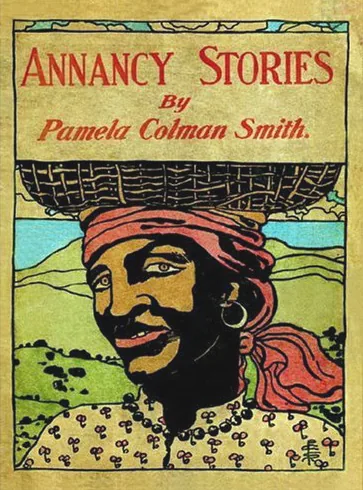
Martha Warren Beckwith’s “Jamaica Anansi Stories”, published in 1924, has free copies online, including page images on HathiTrust and an ebook on Project Gutenberg5. The cover at the top of this page is from an older collection, “Annancy Stories” by Pamela Colman Smith, from 1899. The Anansi story entry in the dictionary has more of the words and phrases that come from the tales.
Common questions
-
Who is Anansi in Jamaican folklore?
Anansi, or Anancy, is a mischievous spider who uses tricks to get what he wants, usually from animals much bigger and stronger than he is, such as Brother Tiger and Brother Dog.
-
Where do Anansi stories come from?
From the Akan culture of West Africa. The word ananse means spider in Twi, an Akan language. Enslaved Africans brought the stories to Jamaica, where they changed and grew.
-
What does Anancy rope tie Anancy mean?
Anancy's own rope ties up Anancy. A trickster ends up caught in his own trick, so a schemer's cunning comes back on him.
-
Where can I read Jamaican Anansi stories?
Martha Warren Beckwith's collection Jamaica Anansi Stories, from 1924, has free copies online, including on HathiTrust and Project Gutenberg. Louise Bennett's Anancy and Miss Lou came out in 1979.
Sources
- Storytelling: The Jamaican Experience Jamaica Information Service
- Miss Lou's Collection: Writing and Performance (MS 2177) National Library of Jamaica
- History Notes: Information on Jamaica's Culture and Heritage (Dinki mini) National Library of Jamaica
- The Magical Spiderman: Anancy (Pieces of the Past, Rebecca Tortello) The Gleaner
- Online books by Martha Warren Beckwith (1871-1959) The Online Books Page, University of Pennsylvania