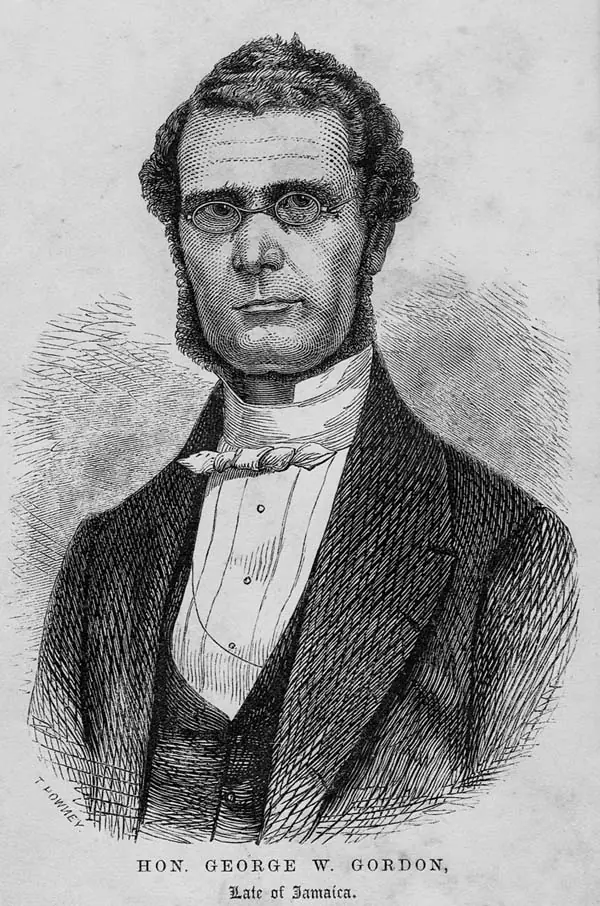

In brief
- George William Gordon was the son of an enslaved mother and a planter. He educated himself, became a landowner in St Thomas and sat in the House of Assembly.
- After the Morant Bay Rebellion of 1865 he was tried by a court martial, convicted without evidence and executed on October 23, 1865.
- He was named a National Hero in 1969.
Who George William Gordon was
George William Gordon was born in St Andrew, near Mavis Bank, some time in the 1820s. His mother was enslaved. His father was a planter who acted as attorney for several sugar estates1.
Gordon taught himself. He became a landowner in St Thomas1 and a member of the House of Assembly2.
What he did
Gordon went into politics when most of the people he spoke for could not vote. He also put his own property to work for them. He divided up his own land and sold farm lots to the people as cheaply as he could, and he organised a marketing system so they could sell what they grew at a fair price1.
He also urged people to protest against their conditions and resist them1. Paul Bogle, the Baptist deacon from Stony Gut, was one of his firm political supporters3.
Morant Bay and his execution
On October 11, 1865, Bogle led a protest march to the courthouse in Morant Bay that ended in bloodshed3. Gordon was arrested and charged with taking part in the rebellion. His government biography describes the court martial that tried him as illegal: there was no evidence against him, yet he was convicted and sentenced to death1.
He was executed on October 23, 18651. Bogle was hanged the following day3.
Why he matters
Gordon is remembered for using a seat in government to speak for people who had none, and for paying for it with his life. His case also shows how the law was turned against him: a military trial that his own government biography calls illegal, and a death sentence without proof.
How Jamaica honours him
George William Gordon was one of three people conferred with the Order of National Hero in 1969, under the National Honours and Awards Act1. His bust stands with those of the other National Heroes in Emancipation Park, Kingston4.
All seven National Heroes are honoured at the Shrine in National Heroes Park, Kingston5. Jamaicans remember the heroes each October on National Heroes Day.
What the honour means
The Order of National Hero can go to anyone born in Jamaica, or who was a Jamaican citizen at the time of their death, who gave the country “service of a most distinguished nature”. A National Hero is styled The Right Excellent, and the order’s motto is “He built a city which hath foundations”2.
Timeline
Further reading
National Heroes
Jamaica Information Service · Government of Jamaica
The government's own short biography of each of the seven National Heroes, with dates. It is the record our hero pages start from.
Good for:Students and anyone checking a date or a name.
Sources
- George William Gordon Jamaica Information Service
- Order of National Hero Jamaica Information Service
- Paul Bogle Jamaica Information Service
- Busts of National Heroes Unveiled in Emancipation Park Jamaica Information Service, June 20, 2018
- The ground where our heroes rest The Gleaner (Dr Lorenzo Gordon), August 9, 2026