
In brief
- Trench Town was built by the Central Housing Authority between 1940 and 1949 on 200 acres of land once known as Trench Pen, with yards designed for communal living.
- Bob Marley lived there. The Jamaica National Heritage Trust calls him Trench Town's best-known resident and says the Wailers were formed at the yard that is now the Culture Yard.
- The Trench Town Culture Yard was designated protected national heritage on May 10, 2007, and has a small museum on the community's history.
How Trench Town was built
Trench Town began as a government housing scheme. Between 1940 and 1949 the Central Housing Authority built it on 200 acres of land known as Trench Pen, which was subdivided to make a new community1. The houses ran from First Street to Seventh Street, between Central Road and West Road1.
The yards were designed for communal living. They had running water and electricity, and the first tenants paid twelve shillings a month. The houses came in four models, labelled H, S, T and U1.
Bob Marley and Trench Town
The Jamaica National Heritage Trust calls Bob Marley Trench Town’s best-known resident1. It was here that Vincent “Tata” Ford, a community leader, taught him to play the guitar, and the trust says the Wailers were formed in the yard that is now the Culture Yard1. Bob Marley, Peter Tosh and Bunny Wailer, who first met in Kingston, went on to carry reggae around the world3.
The trust also connects two famous songs to the yard. It says “No Woman, No Cry” was co-written there by Marley and Ford, and that “Natty Dread” recalls Marley’s trips between First and Seventh Streets1. UNESCO, describing reggae, places its origins in a cultural space home to marginalised groups, mainly in Western Kingston2.
The Trench Town Culture Yard
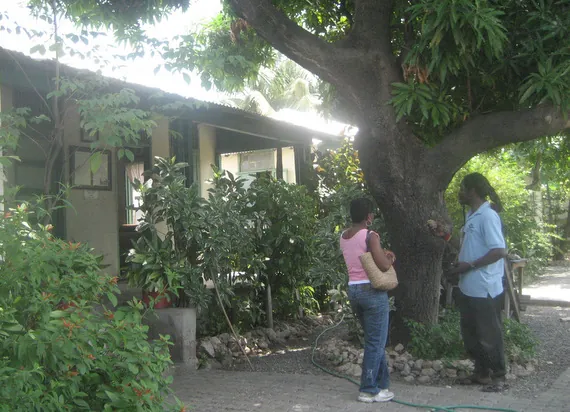
The Culture Yard is at 6 and 8 Lower First Street. Its 1940s buildings have been restored, and a small museum covers the history of Trench Town. It displays articles, instruments and furnishings used by Tata Ford, Bob Marley, Peter Tosh and Bunny Wailer1.
The site also has the Casbah Cafe, the Lion of Judah Courtyard, craft shops and restrooms1. It was designated protected national heritage on May 10, 20071.
Visiting
Contact the Culture Yard for opening hours and prices before you go, and ask about a guided tour. Marley’s later home, now the Bob Marley Museum, is across the city on Hope Road, and our Kingston heritage guide covers other stops downtown.
Visiting
- Access
- The Trench Town Culture Yard, at 6 and 8 Lower First Street, has a small museum, a cafe, a courtyard, craft shops and restrooms for visitors.
- Official page
- jnht.com
Contact the Culture Yard for opening hours and prices before you go, and ask about a guided tour of the yard and the community. 1
Timeline
Common questions
-
Where is Trench Town?
In Kingston, Jamaica. It was laid out from First Street to Seventh Street, between Central Road and West Road.
-
Did Bob Marley live in Trench Town?
Yes. The Jamaica National Heritage Trust calls him Trench Town's best-known resident. He learned guitar there from Vincent "Tata" Ford, and the Wailers were formed at the yard that is now the Culture Yard.
-
What is the Trench Town Culture Yard?
A restored government yard at 6 and 8 Lower First Street, with a small museum on the history of Trench Town. It was designated protected national heritage on May 10, 2007.
Sources
- Trench Town Culture Yard Jamaica National Heritage Trust
- Reggae music of Jamaica UNESCO Intangible Cultural Heritage
- The Evolution of Music in Kingston, Jamaica African Caribbean Institute of Jamaica / Jamaica Memory Bank, Institute of Jamaica